
ABOUT

Decoloniz(s)e Knowledge Flow
What might decoloniz(s)ing knowledge look like?
"Decoloniz(s)ing Knowledge Through Performance and Technology: A Collaborative Research Approach" is a collaborative explorative learning project, designed and facilitated by Antje Budde (University of Toronto, CAN), Milija Gluhovic and Silvija Jestrovic (University of Warwick, UK).
This project is funded by a joint seed grant offered and operated through the University of Toronto and Warwick University.


Meet The Facilitators
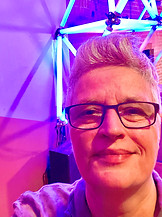
Antje Budde
Antje Budde (安琪。布德) studied theatre sciences (Theaterwissen-schaften), cultural communication and modern Chinese Studies at Humboldt-University in Berlin and at the Central Academy of Drama (中央戏剧学院) , Beijing.
Antje has co-founded several artistic collectives and labs, grounded in critical practices of queer-feminist artistic research.
Budde’s research in recent years focussed on digital literacy, digital dramaturgy in/as experimental performance, the interdisciplinary concept of the performing arts/media as “being for others”, disappearing technologies/ anArcheology/ sustainability, and the development of a critical and innovating praxis and philosophy of A/I (artistic intelligence) in the context of AI imperialism/ colonialism and the harmful disentanglement of the material reality from the virtual.

Milija Gluhovic
Milija Gluhovic is Professor in Theatre and Performance at the University of Warwick. Milija joined the School in September of 2006. He holds a BA in English (Hons) from the University of Novi Sad, an MA in English from the University of British Columbia, and a PhD in Drama from the University of Toronto (2005). He was Director of the Erasmus Mundus MA in International Performance Research (2010-2015), an EU-sponsored programme taught collaboratively by the University of Warwick, the University of Amsterdam, the University of Helsinki, the University of Arts in Belgrade, and Trinity College Dublin. He currently serves as an elected member of the Executive Committee for the International Federation for Theatre Research (IFTR).

Farjana Kabir
Farjana Kabir (she/her) is a Doctoral Researcher in Theatre and Performance Studies and an IAS Early Career Fellow at Warwick University. Her thesis, Theatre of Transformation: An Autoethnography, critiques the charitable model of applied theatre for displaced women. Using a rigorous Practice as Research (PaR) methodology, Kabir demonstrates that theatre offers a relational and iterative environment for rehearsing democratic life, supporting women in developing new social and political identities.
Originally from Bangladesh, Farjana began her career as a theatre activist working with street children, later expanding into television and community-led arts. Since relocating to the UK several years ago, she has used autoethnography to connect her personal history with her professional practice, examining how migration, belonging, and exclusion influence society. Her film “5 am” was featured by Manchester UNESCO City of Literature in a global live-streamed event for the UN’s International Mother Tongue Day.
Her current portfolio includes the performance installation The Kitchen Window Diaries (2025) and the film A Weed is Still a Flower (2024). Farjana’s collaborative projects include work with the Octagon Theatre’s Women’s Group, directing for Tower Hamlets Council’s Bangla Drama Season, and installation and performance work for the V&A London. In partnership with Community Arts Northwest, she supports the recognition of marginalised voices as expert sources of knowledge.

Silvija Jestrovic
Silvija Jestrovic studied playwriting and dramaturgy at the University of Belgrade (1989–1992) and completed her postgraduate studies at the University of Toronto in 2002. From 1990 to 1996 she worked as a freelance playwright, dramaturge and television journalist. Before coming to Warwick in 2005, Silvija was SSHRC Postdoctoral Fellow and lecturer at York University in Toronto. Whilst at Warwick she has designed modules that address her interest in performance and exile, avant-garde theatre, playwriting, and theatre and performance theory. She also has a special interest in the interdisciplinary and collaborative research and teaching. This is reflected through her on-going international partnership with colleagues from the Jawaharlal Nehru University (India) and University of Arts Belgrade (Serbia) among others, and in her work with the Warwick Politics and Performance Network.

Jill
Carter
Jill Carter (Anishinaabe-Ashkenazi) is an Associate Professor cross-appointed to the Centre for Drama, Theatre and Performance Studies (CDTPS) and the Transitional Year Programme (TYP) at the University of Toronto. At the CDTPS, she serves as the Associate Director, Graduate. As a researcher and theatre-worker, she works with emerging and established Indigenous artists to support the development of new works and to disseminate artistic objectives, process, and outcomes through community-driven research projects. The research questions she pursues revolve around the mechanics of story creation, the processes of delivery and the manufacture of affect. More recently, she has concentrated upon Indigenous pedagogical models for the rehearsal studio and the lecture hall; the application of Indigenous [insurgent] research methods within performance studies; the politics of land acknowledgements; and land-based dramaturgies/activations/interventions.
Apart from her teaching, theatre work and academic writing, Jill is a member of the Indigenous Dramaturgy Lab; works as a researcher and tour guide with First Story, Toronto; and works with the Directors Lab North as Artistic Associate. Recent projects Finding Fanon--Artist, Activist, Healer An Arts Based Investigation for which she served as Co-curator, Dramaturg and Director https://www.humanities.utoronto.ca/events/finding-fanon%E2%80%94artist-healer-activist-arts-based-investigation-day-1 ; A Century of Sparrows (by Sierra Rosetta) for which she served as Dramaturg at the Native Voices Theater Company: Autry Museum of the American West. Los Angeles; and Who Will Save the Night Sky? (by Philip Geller) for which she served as Dramaturg (Elders and Traditional People’s Gathering. Nozhem First Peoples’ Performance Space)
As a member of the Talking Treaties Collective, she is co-author of A Treaty Guide for Torontonians. With the Collective Encounter, she is co-author of Retreating to Re-Treat: A Performative Encounter at ‘the Edge of the Woods.’ In 2024, the Literary Managers and Dramaturgs of the Americas (LMDA) awarded Jill the Elliott Hayes Award for Outstanding Achievement in Dramaturgy for “Encounters at the ‘Edge of the Woods,’” which opened Hart House Theatre’s centenary season in 2019, and which is included in Retreating to Re-Treat (Playwrights Canada Press, 2024) Her Between the Layers: Spiderwoman Theater, Storyweaving and Survivance (UT Press) was published in spring 2025.